|
I started my grammar
school career at John Ruskin in 1949 and can just remember my
first days there although many memories of those early times
are fading with the years. I think my earliest memory from my
very first days is of Prefects, a species I had not come across
before. I can remember some of them standing on top of the steps
from the playground into school, shouting orders to do this
or that. I had probably read "Tom Brown's Schooldays" before
then so knew something of the powers these boys had over lesser
mortals in school. (Believe it or not, but books and stories
about school life were quite popular in those days!) I believe
they (the prefects) even had a Room or Den of their own and
before long I discovered that they could dish out "lines", "detentions"
and other such punishments for various misdemeanours. Definitely
people to keep on the right side of and to hold in some kind
of awe. I do not recollect any ambition on my part to take their
place in later years though. I was probably not cut out, even
then, to be a leader of men or boys in this case.
I know that Mr. Cracknell became deputy head in later years, but whether
he was when I was at Tamworth Road or not, I do not recollect.
I know that I started off in Class 1C, which may have been Mr.
Cracknell's (C for Cracknell) or was it Mr. Cresswell's? I really
forget now! Then I went on to 2B, Mr. Brooks, in year two. Mr.
Brooks had a large plimsoll with which he meted out punishments
across the backside if work or behaviour was not up to standard.
He was also known to throw it at offenders in the class room.
I still have my set of Log Tables which were purchased that
year and still has the class name 2B on the cover! 3G was next
with Mr. Griffiths who I think taught English. Year four was
with Mr. Peacock, 4P and Mr. Alexander in the fifth in 5A. I
actually did two years in the fifth because I flunked most of
my "O" Levels the first time around! I cannot remember now whether
I was in 5A for both years or whether I had a different form
teacher for one or other. Mr. Alexander left that Easter (1955),
so at least my final term until the July would have been in
a different class. The last two terms of my second fifth year
were spent at the Shirley Road establishment when it first opened
in January 1955. I can report that I did pass all the exams
that second year apart from a one year experimental course of
Spanish with Mr. Richardson (known as 'Bon' after his frequently-used
expression after one had given a correct answer in a French
lesson) for which I did not sit an exam.
I had aspirations to become a Quantity Surveyor in those latter days,
quite a different tack to becoming a Farmer which was the year-three
desire. I remember sitting in History lessons with a friend
reading Farmer's Weekly Magazine which probably helped me to
be unsuccessful at History! I did go on to start as a Quantity
Surveyor in an office in London, a career I pursued for two
or three years, before changing course completely. One of the
requirements for by-passing the very first FRICS exam level
was to have not only the necessary subjects passed at "O" level,
but to have got them all at one sitting. This is why I did two
years in the fifth form in an attempt to include Maths (the
only subject I passed first time round) in the second sitting.
By and large I did not shine academically at school. I can remember
being goaded into periods of revision at home ready for annual
exams and finding that something of a struggle, especially as
the results were not that encouraging afterwards. Somehow or
another, in year three, I managed to avoid such heavy revision
sessions and my results were suddenly much better! At least
one science subject giving me a position near the top of the
class. I have never been that keen on last minute revision sessions
ever since!
The chemistry and biology labs were in a building out at the back of
the main school building and Mr. Chaundy's physics lab was somewhere
inside main school. Thinking of Chemistry, on one occasion I
remember Mr. Pearman setting up an experiment to make chlorine
gas. Unfortunately for him, there was a leak in the pipe work
somewhere and he suffered quite badly from chlorine gas inhalation.
He had to sit down outside in the fresh air taking frequent
sniffs at a bottle of ammonia which presumably was some form
of antidote. We students had to walk round and round the outside
of the lab in an attempt to clear our lungs of the gas with
anybody who felt ill taking some sniffs of ammonia as well.
On another occasion we also did the common student trick of
connecting the Bunsen burners to the water tap instead of the
gas tap and putting everybody's burner out on that bench. I
did not take science subjects in the fourth and fifth year options.
Those subject options were laid out in a three by three square of nine
subjects and we could take any straight line of three, up across
or diagonal. The compulsories were Maths, English Language and
English Literature and I finished up taking French and Geography
as well as Woodwork in which we did not take an exam whilst
at school. P.E. and games were also mandatory. That does not
seem very many subjects by today's standards, but that was how
it was.
I might add at this juncture that I eventually became a secondary school
Teacher of Woodwork myself and I remember going for interview
in 1956 for a place at Shoreditch College in 1959. I was told
by the Principal to not waste my time in the RAF (to have completed
National Service was a requirement of entry to college in those
days) and he added, "You do not even have Woodwork "O" Level".
I took that as something of a challenge so I bought myself a
set of standard school Woodwork text books which I studied whilst
away (in Cyprus for eighteen months) and arranged to go back
to John Ruskin in 1959 to sit my "O" Level Woodwork exam. I
relied on my practical skills gained whilst at school to carry
me through the practical exam element. I am glad to say that
I passed with no trouble!
Of the other teachers there at the time, I remember Mr. Smith (Smut)
who took us for P.E. I believe he had been a naval PTI. before
he became a teacher. Everybody was in awe of his stern reproaches
and ability to command silence and control with just a look.
I can remember him coming down to the changing room (which I
think was a cloakroom really) one day after we had been making
a lot of noise getting ready for his lesson. He came in with
a heavy scowl, leant against the door post and said two words,
"Get changed!" Since we were already by that time dressed for
P.E., we had to get changed back into school clothes, in absolute
silence of course. As soon as we were changed, he growled again,
"Get changed!" So we did; backwards and forwards that went on,
all through the lesson! I do not think that we were quite so
noisy next time, so his methods worked, I suppose. Nevertheless,
I quite liked his lessons although that was another subject
in which I did not shine, either P.E. of Games. So far I was
not shining either academically or physically!
Mr. Rees took us for Latin. A little Welshman with a strong accent,
I remember him coming into class at the beginning of a new year,
rubbing his hands together and enquiring whether we were, "Ready
for another year's Laaatin?". Another subject in which I failed
miserably and did not take past third year! Nevertheless, in
later years I have had occasion to be grateful for the few small
smatterings of that language which I did manage to pick up that
have helped me to some understanding or aspect of language,
English or otherwise.
Mr. Fisher taught us French. Small of stature with black hair gelled
flat to his head, a swarthy complexion and a permanent five
o'clock shadow. I went past the staff room on more than one
occasion and spotted him through an open door shaving during
the day. Whether he organised it or not I forget, but I did
join Le Cèrcle Français at some stage. This was an opportunity
to practice one's conversational French, which I quite enjoyed
and, since this must have been at a time of some hormonal activity,
it also provided an opportunity to visit some neighbouring girls'
schools, probably Old Palace and Coloma, for further conversational
practice; this I too enjoyed! We were frequently cajoled, usually
by the girls' teachers to, "Parlez Français, parlez Français,
pas Anglais!!" (It should be remembered that whatever changes
took place at Ruskin after I left, this was a time when it was
an all boys school; girls and boys were generally to be kept
apart as far as practicable.)
My Maths teacher was Mr. Alexander with whom I got on quite well, probably
because this was one of the few subjects in which I did quite
well. So much so that I gained top marks, or very close, in
the school at "O" Level, around 93% I believe. I have been trying
to sort this out in my mind for chronological accuracy, but
when I looked at both my book prizes just now, I see that they
are both for Senior Handicraft. Although they are not dated,
they must haven been for 1954 and 1955. The first would have
been in 1954 since neither books were published until that year,
and so any Maths prize I may have qualified for would have been
awarded after the results were out for that year and would normally
be given to students in their first sixth year for which I was
not initially going to stay on. As it happened, in what was
my second fifth year, I was again awarded the Senior Handicraft
prize, so I must have tied for top place for maths the previous
year and the maths prize, of which there was only one, was given
to the other chap. Taking the maths exam again in 1955, I achieved
96% the second time, but I never got a maths prize! Just the
two Senior Handicraft.
I think most of us had different teachers through the years at school
and at least some of my English lessons were taken by Mr. Cracknell
who was a stern master and with whom one did not mess around.
He went on to become deputy head in my later years at Ruskin
but he too was off sick for quite some time during 1954, although
he did survive to return of course. His place was taken during
his absence by Mr. G H Vallins whom we thought must have been
very famous because he had written books (published by Pan Books)
on English Language.
Of the Headmaster, Mr. Lowe, throughout my school career, I do not
have all that many memories apart from being able to recognise
him instantly in any photographs of the time. I still have the
letter from him in response to my query to the school some time
after I had left, about how to go about becoming a woodwork
teacher and enclosing the information about colleges which came
from the then woodwork teacher up at Shirley Road.
The other subject at which I achieved some success, as described above,
was Woodwork, initially with dear old Mr. Chinnock, although
he regrettably died in 1954 after being off school for several
months. He had joined the school in 1938 and it was he who undoubtedly
sowed the seeds of craftsmanship in me which were to pave the
way and shape the path for my chosen career through most of
the rest of my life, or certainly a large portion of it.
A temporary locum teacher was appointed to take Mr. Chinnock's place
until he returned, although as it happened he never did. This
was initially Mr. Crampton who arrived at school on an ancient
motor-cycle with several parts secured to the machine by string.
I remember him as being quite fun although I do not think his
woodwork skills were in quite the same class as Mr. Chinnock's.
He became something of a school character for the time he was
there with some fairly outrageous dress sense for that time.
Bow ties and cravats were not often seen around grammar school
teacher's necks, they did not "go" with academic gowns, which
Mr. Crampton did not have anyway.
I was to meet up with Mr. Crampton again some years after leaving school.
I had been working in a Quantity Surveyor's office in London
for about a year and a half and it was beginning to pall, to
be honest, partly because I was never sent out on site to relieve
the tedium of office work. I was walking through one of the
London parks one lunch time and was hailed by a man who turned
out to be Mr. Crampton, by now working in a different school.
It transpired that his father, who was a quantity surveyor in
Birmingham, was opening a new branch office in London and was
recruiting workers including my level of "Worker-Up". Thus I
went to work in a nice newly refurbished office in Baker Street,
quite different to the old, dusty, floor-boarded offices I inhabited
before. Nevertheless, by this time having made the decision
to become a teacher rather than pursue the surveying career,
I only stayed there a few months before accepting conscription
and ultimately, after demobilisation, going back to the first
surveyor's office to continue working there for six months until
the college term started in September.
John Ruskin School Prize Giving was carried out at Speech Day, an event
that took place at The Civic Hall then in Croydon's Surrey Street
I think, the entrance to which was next to Turner's wonderful
Tool Shop. I believe there was a rehearsal on the Friday and
the event itself was held on a Saturday afternoon or evening
and everybody was expected to attend. It was traditional for
the Head Boy to give a speech thanking the guest speaker and
requesting a half-day's holiday to make up for the loss of a
Saturday evening although it was spoken of as a reward for hard
work and splendid results at school! We were always given that
holiday. As a school photographer, I was often able to take
a place on the balcony so that I could photograph the prize
winners being given their prizes on the stage below from a vantage
point. I remember on one occasion that I was using a flash-button.
This was a device used instead of a flash-bulb and was actually
not much more than an adaptation of the magnesium powder used
in earlier years in a tray and then ignited with a spark. The
buttons contained the powder and the ignition came from the
batteries in the flash-gun triggering off a spark within the
button. The result was basically a contained magnesium powder
explosion. I think I may have had a reflector behind it as per
a normal flash gun. For such an event I would usually choose
those big screw-in flash bulbs that press photographers used
at that time. The buttons fitted in an adaptor in the same flash
gun. The remembered speech day occasion was when I fired off
one of these buttons and it exploded in a way it was not intended
to and showered those below with sparks of burning magnesium
powder! I would add that this was not a normal incident and
that I had successfully used them before, but those big flash
bulbs were much more expensive than the buttons, so they were
worth trying.
One morning we were alarmed to hear on the news that there had been
a fatal shooting of a policeman during a raid at Barlowe and
Parker's sweet factory in Tamworth Road the night before, which
was only a few houses away from the school. Wasn't somebody
hanged for the offence of which there was subsequently some
controversy about the case? I do remember seeing a documentary
about it some years back, even if the details allude me now.
I remember thinking on the way to school that morning that we
would see the factory peppered with gun shots, but not so was
the case.
[Cliff Cummins writes: The shooting of a policeman at
Barlowe and Parker was the infamous Craig and Bentley case,
which centreed around a phrase "Let him have it." Did this mean:
"Let him have the gun," or "Shoot him?"]
[Mel Lambert adds: For many, the murder case illustrated
a misapplication of the death penalty. In 1953, Derek Bentley,
a slow-witted, easily-led young man, was hanged for his alleged
part in the killing of a police officer. It was a case that
at the time received much notoriety. Although Bentley's working-class
parents tried to ensure that their son stayed on the straight
and narrow, one night - wanting to be one of the boys - he simply
hooked up with the wrong crowd. Although Bentley was unarmed,
another of the other boys was not. When an inevitable clash
with the police came about an officer was shot. Bentley's famous
words, "Let him have it", were the catalyst for his trial, conviction,
and eventual execution. Despite his learning disability, the
ambiguity of the statement attributed to him, and his tangential
involvement during the shootout with the police, Bentley was
given the death penalty. It was always Bentley's position that
he meant for the shooter to let the police have the gun. In
July 1998, after persistent efforts by sister, Bentley was finally
exonerated.]
Who remembers the tuck shop across the road on the corner opposite
Barlowe & Parker? Always a popular place to visit, even if it
did mean crossing the busy Tamworth Road although this was before
the time when it was considered too dangerous for young people
to be allowed to do such things without a Lollipop person! I
remember drinking strange coloured drinks, goodness knows what
was in them to make the colour. I remember too a little bakers
shop in a small road which came out in North Street, where Woolworth's
was anyway, which sold great bags full of broken cream slices.
Put your hand in and bring it out full of lovely cream and puff
pastry and icing sugar; makes my mouth water just thinking of
it! You used to be able to buy broken biscuits in Woolworth's
too then, which were displayed (in their loose, whole form)
in tins, long before pre-packaged biscuits were the norm.
Of the move from Tamworth Road to Upper Shirley Road I do not remember
much beyond the previous visits I made to the school to take
photographs, some of which can be seen elsewhere on this web
site, of building progress and the surrounding areas where things
were not quite finished when we started there in the January.
We used to cycle to school more often than not. I lived then in Shirley,
or more accurately perhaps, despite the address, in Monks Orchard.
It was not long before I became very keen on cycling and had
soon built up a quite reasonable racing-type machine although
I never actually took part in races. I did take very long rides
though often along with other like-minded chaps from the school.
I recollect a very dangerous practice of going home at high
speed along the Shirley Road (from the Tamworth Road school,
this was) and tucking in behind a bus out of its slip-stream
then putting our front wheels right up onto the rubbing strip
of the back of the bus just behind the platform and leaving
a black burn line on it. In the course of the journey a two
or three of us could leave several black marks!
Another thing that occurred about this time was testosterone and various
other hormones started racing around inside me causing problems,
well not problems really, it was quite nice actually, although
it probably had quite a lot to do with why I was not more successful
academically at school, in fact I am sure it was.
School trips. I think I only went on one. That was to Switzerland to
a village called Aeschi near Lake Thun probably about
1954. It was led by Mr. Smith and I think Mr. Richardson, and
Mrs. Garwood who was the school secretary. I still have some
photographs of the occasion although very few show anything
other than views, none, bar one, of people.
I can remember going to the cinema in Croydon, possibly the whole school
or maybe just one year, that I do not remember, to see the film
about the conquest of Everest and on another occasion sitting
in the hall to hear a broadcast which in memory was the coronation,
although logic now tells me that it would have been more likely
that we had a day's holiday for that occasion.
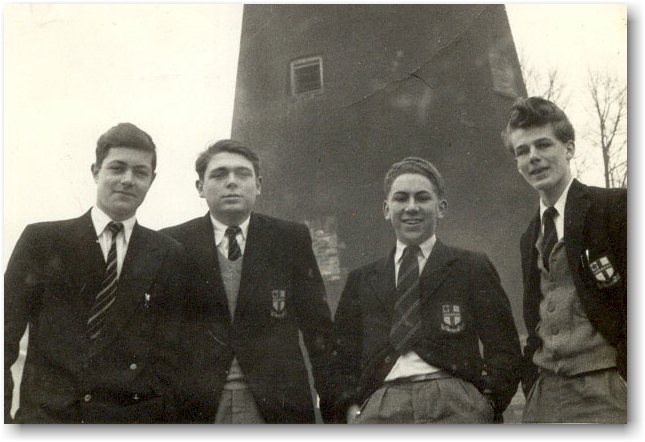
Not a school trip as such, but I started to go Youth Hostelling from
about 1951 and one trip in 1954 was with three other lads from
school when we cycled down to Swanage stopping off at Winchester
and Gosport hostels on the way. Last year (2000) whilst on holiday
we went along that road from the Sandbanks Ferry to Studland
and Swanage which we must have taken in 1954 and I swear that
it hadn't changed one little bit! It certainly brought the memories
flooding back. It's a road with very little on it, then or now,
apart from an increase in traffic of course. I suddenly had
a 48 year time-slip and thought I was again cycling along that
road with my three friends!
I have already described what I did directly after leaving school in
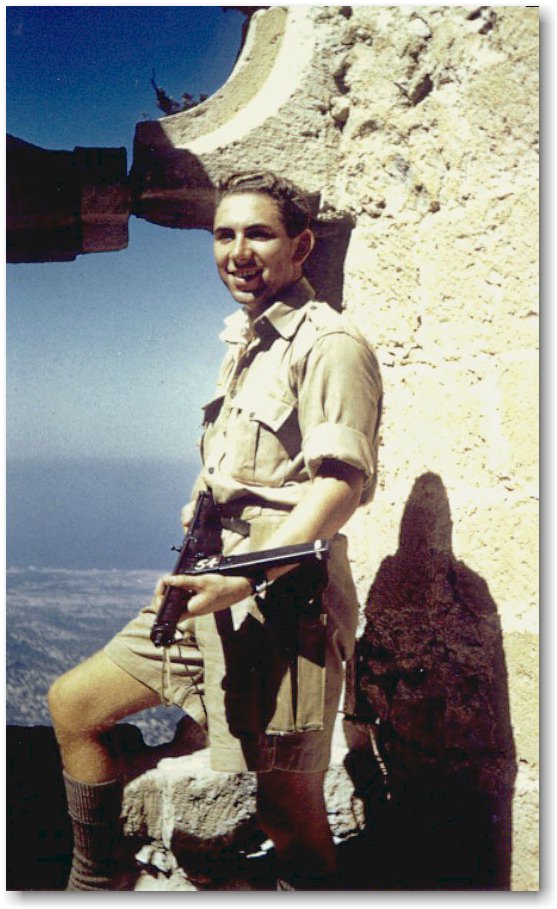
1955 and alluded to other career changes. I went into the Royal
Air Force in February 1957 and subsequently trained as a Teleprinter
Mechanic. I think I did better with that than anything I did
at school actually. I was posted to Cyprus where I stayed for
the rest of that period. Coming out in 1959 I approached the
makers of teleprinters, Creed's of Croydon, for a job but they
considered that the knowledge and experienced gained in the
RAF, although perfectly adequate for what I did there, was not
as deep as they required to take me on. That is how I came to
go back to my first quantity surveyor's office until the September
when I went to college. I also went back to that office from
time to time during the college holidays to earn a bit of cash
and right at the end of the course I was often to be found on
the train up to town in the morning for a full day's work, even
to the extent of picking up a packed lunch from the college
canteen, whilst I was still "attending" college. In those days,
like at school, one still had to stay at college after sitting
one's exams until the very last day of term whenever that was,
even if this meant just whiling away time. That also accounted
for quite some time I spent at Ruskin in the new woodwork shop
at Shirley Road helping the teacher get it ready for occupation
that coming September. It was not fully useable during those
first couple of terms, or was it that a full-time teacher had
not at that point been appointed? Possibly the chap I was helping
was the new teacher coming in to get things sorted.
Having qualified as a teacher of woodwork (with Merit - I must have
been getting better, or was I a "late developer"?!) in 1961,
I took a job at the William Penn Comprehensive School at Dulwich,
one of the first of the comprehensive schools to appear in London,
with 1,600 boys. I stayed there until 1965 by which time I had
achieved a post of responsibility for Audio Visual Aids.
I was heavily involved with Scouting in those days and in 1964 I went
with my Troop the 29th Croydon, to Norfolk for the summer camp
near Sandringham. Thinking that this was a nice part of the
country, I started applying for jobs in East Anglia and in 1965
was appointed to be in charge of teaching woodwork at the Sudbury
Secondary Boys' School in south West Suffolk (the county was
split into East and West then). There were 365 boys on role
this time, quite a change from the large school in London. We
came to Sudbury with our first son then two years old and our
second was born that same year. We're still here in the same
house. Who was it I read about in your pages who had changed
house some 30 times in the course of his working career? I also
became involved with examination marking, moderation and assessment
with the local CSE board in those years, carrying out that work
for the next twenty years or so altogether.
I stayed at that school until the county reorganised and "went comprehensive"
in 1972, but in 1971 I decided to go back to college for the
additional supplementary third year of training. Still salaried
of course! Quite apart from anything else, it would take me
out of all the moving traumas that would have been prevalent
there as well, no doubt, as at Ruskin at the end of 1954.
I had to re-apply for my job, not because I had been away - everybody
had to, and in 1972 I started at the Sudbury Upper School again
in charge of teaching woodwork. This was a mixed school so we
met up with girls in school for the first time which in my case
had not happened since teaching-practice days! I happily went
on there doing what I had been trained to do and which I enjoyed
but gradually the winds of change started to blow and the idea
of "Technology" and "CDT" started to waft around. It was not
long before woodwork became known as "Craft, Design and Technology"
and Woodwork as a subject started to lose its direction. Trouble
was, nobody really understood what we were supposed to be doing
instead or how to do it and even on the training courses provided,
they did not really have much idea. Little money was put forward
for the changes and I think I received more towards metrication
than any change towards Technology. Also at that time less and
less money was available for woodwork and none was put towards
the increasing cost of timber. Instead of being able to offer
students good quality hardwoods for their projects, I was reduced
to scrounging off-cuts from local factories and saw-mills. The
subject went downhill from there and eventually it became a
bad word altogether. Students were put off, staff were disinterested
and disillusioned and for me the final straw came when I was
approached by a local woodworking firm to offer them a suitable
student for an apprenticeship. I could not honestly put forward
one name from my woodwork class, or whatever it was called that
year, who was interested enough or who might make an apprentice.
Later that year, 1985, I had what is best described as a nervous
breakdown and I could not return to school. I stayed off work
for the next eighteen months and retired with some pension enhancement
in 1986.
What next to do? Fairly recently I had taken a correspondence course
in horology with the British Horological Institute. I must have
been improving by then because I came through their first year
exam with top marks in the country and won a cash prize for
my efforts! Nevertheless I was not ready to follow in my father's
footsteps as a watch and clock maker and decided that I would
start up a Wood-Turning business instead as I had always been
particularly keen on woodturning. But where and how?.
One day in the local East Anglian newspaper there was an article about
a museum in Stowmarket in Suffolk about 20 miles from here who
were having a new building created with craft workshops inside.
These were in the main to be static displays but I wrote to
the Principal and put forward some suggestion if he were at
all interested. He was, and from that interview with him I was
able to build a woodturning workshop within their wheelwrighting
display area. However, I did have to recreate the wheelwright's
workshop first, moving it from an earlier part of the museum.
I was to be involved with a lot of the finishing work to the
building and displays before it opened at Easter 1986. It was
officially opened later that year by the Duke of Gloucester
who was presented with one of my turned bowls. The wheelwright
shop I was given free rein to do as I liked with and in but
I was also expected to become proficient enough to be able to
talk to visitors about wheelwrighting as well as my own turning.
I could sell my work and was not expected to pay anything for
rent or power, they even bought a second-hand lathe for me to
use and paid my traveling expenses. Thus was born my wood-turning
career. I had a distant relative who had been a wheelwright
in Dorset, so we visited him and I learnt a lot about the craft,
I read a lot about it but I never actually built a wheel although
I did have some requests so to do. I wrote a small book on the
subject which I sold for a couple of pounds. Income was never
great but just adequate enough to pay for the car and one or
two other running aspects of the business. During the winter
when the museum was closed I worked on museum projects for which
I was paid. I became a member of the Worshipful Company of Turners
or at least I was on their register of turners. I was also doing
various independent woodworking jobs and turning repairs for
antique furniture restorers.
By about 1991 when the recession was biting the museum visitor numbers
began to drop off and of those who did come fewer were buying
my wares. Then two things came about. First of all through the
Worshipful Company I was offered repetitive turning work, quite
boring really but it paid the bills. Then a little later I was
approached by the then Head of CDT department at the Upper School
to see whether I could help them out as their workshop technician
was off on long-term sick leave. I had also done some census
work that year, so one more job was added to the list along
with the turning. By that time the principal at the museum had
changed twice, so the chap who took me on, who was an ex-history
teacher and with whom I got on very well, was no longer there.
I had already built a turning workshop at home for when I needed
to do work there or the weather was too bad to get to the museum
in the winter. I was going to school to help out there in the
mornings, going straight on to the museum for the afternoons
and doing some turning at home too. Most of the repetitive turning
work was making tailor's dummy's necks and before I finished
I had made over 16,500 of them!.
As a result of my appearing for shorter hours at the museum they took
it upon themselves to stop my traveling allowance at one stage
in 1992, the upshot of which was that I walked out! Three full
car loads of my own stuff, wood and tools mainly, I emptied
from that workshop. But I left something of myself there. The
wheelwright shop I felt was more or less my own creation and
my picture appeared on some of their postcards and also on their
tea-towel. The postcards have long since gone, but the tea-towel
was still on sale earlier this year when I went there (to visit
the annual beer festival!).
I continued with the turning work in the home workshop working at weekends
and evenings after a day at school. The morning-only session
in the school workshop had expanded to include an afternoon
working in the computer department maintaining the network.
So I was back to working a full school day although my pay was
actually only for the 200 days worked and this was considered
part-time although the salary was paid monthly throughout the
year.
Then the turning work started to dry up and I heard nothing for months
on end and eventually I decided to sell my home lathe which
was a big one with all the tools and cut my losses and to pay
the tax man!.
After six years at school again, the head of department left to go
to an independent school some way away. We took on another who
was, not to put too fine a point on it, pretty useless and with
whom no-one could get on or work with, not least the students.
Then out of the blue I had a phone call from the previous chap
enquiring whether I would be interested in a full time job at
his school working entirely on computers? I jumped at the chance
after asking whether they realised how old I was (then 61).
I went for interview, once with the Head of IT and again with
the Headmaster, ten days from original phone call to handing
in notice at the Upper School! It was to be longer hours, longer
holidays (15 weeks), full time and full pay but more of it.
Landed on my feet again! It's not often someone of my age is
offered a job, least of all without having to apply for it.
I even had to draw my second county council pension for those
last years at school. They had bought in my private pension
plans too but the new school did not want to offer anything
else in the way of a pension.
So that is where I have been ever since, I am now in my third year
there. My work involves looking after the school computer network
which now has over a hundred and thirty stations and being expanded
all the time. It's hard and long work but I enjoy it and also
the surroundings, but I won't wax too lyrical about it all here.
My contract now runs until the end of August four months after
my 65th birthday. It is all quite worth the 47 mile round trip
I have to drive each day to get there too. Ironically, after
my father died we bought a new car which we said would take
us caravanning and last us through our retirement, then I went
and changed jobs and suddenly, as it comes up to its first MOT,
it has done 33,000 miles instead of the five or six thousand
we had anticipated by that time!.
So that is me up to date work-wise. What else do I do or have done
that may be of any interest? I became a Radio Amateur (Ham)
back in 1973 after being spurred on by a then-new electronics
course offered at college during that third supplementary year
in 1972. Hence the G4GGC in my e-mail address which is my full
class-A call sign. I have carried this interest on ever since
and for a while I successfully taught adult students for the
City and Guilds examination needed to qualify for a radio amateur's
license. I also taught adults at evening classes in woodwork
for many, many years. My interest in Scouting carried on for
a long time and I was eventually District Commissioner for Scouts
here in Sudbury for several years. I started to learn to fly
during the late eighties but could not afford to continue it
for very long, I didn't even get as far as going solo which
I had hoped to do.
I have undertaken a great many walking trips through the fells of the
Lake District over the years, mostly with parties of school
children but also with family and friends. Now I fear that increasing
age and various medical problems that go along with that have
probably ruled this activity out.
When I was younger I was a canoeing and county sailing instructor and
did those a lot. I have played the church organ at services
for many years but I have not done so now for a few, my mother's
funeral and our younger son's wedding were the last occasions.
I have an extremely good friend in a German Radio Amateur whom I met
on the air on teleprinters back in 1979 and we have kept in
touch ever since. He has been over here many times usually staying
with us for all or part of his holiday, although we have only
been able to afford
to visit him in Bavaria the once over Christmas and New Year
1986/7.
Five years ago we bought our first caravan having not towed before.
It is quite old (1979 in fact) but we have made it snug and
we enjoy our caravanning holidays, this year (2001) taking it
right up to north west Scotland for four weeks, this being my
wife's retirement treat.
I am still taking a lot of photographs although I went digital last
year which is quite a change into something different which
also involves using the computer of course although despite
working with them all day, I still do a lot with at home as
well. I have just
taken up digital video photography which is quite a new departure
for me. I have played some bowls with a local club although
with this job that has taken something of a back seat for a
year or two.
I enjoy a good single malt when I can afford it, red wine and, being
a member of CAMRA, a good real ale! Preferably I like those
stronger beers at around the 5% ABV mark which I consider usually
have more taste.
Presently I belong
to the The Royal British Legion as a committee member and
serve as
standard bearer
for the
Sudbury Branch. I think that brings me right up to date for
now.
Mike Marsh, Great Cornard,
Sudbury, Suffolk, November 2002;Updated August 2003
email
|